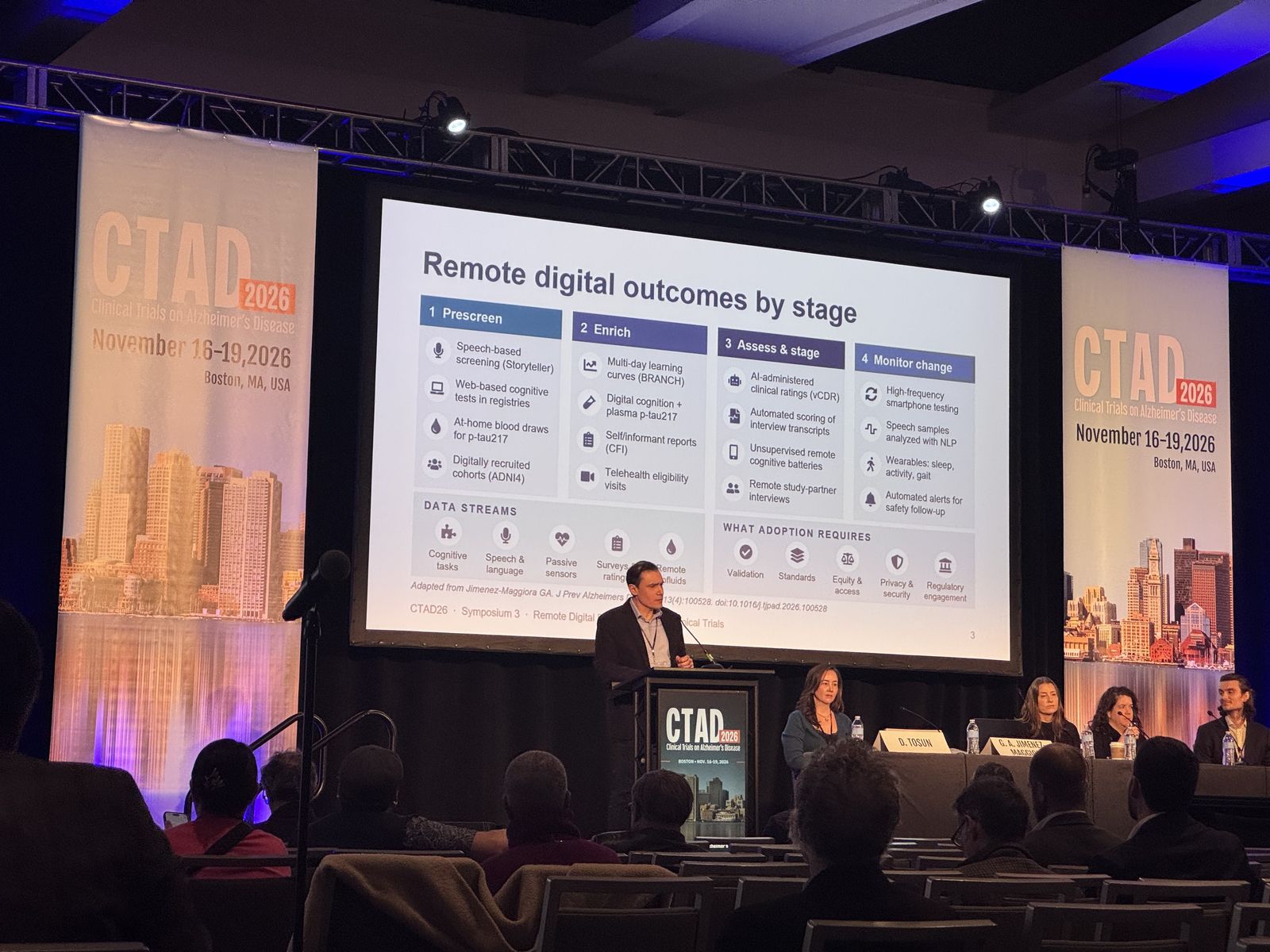
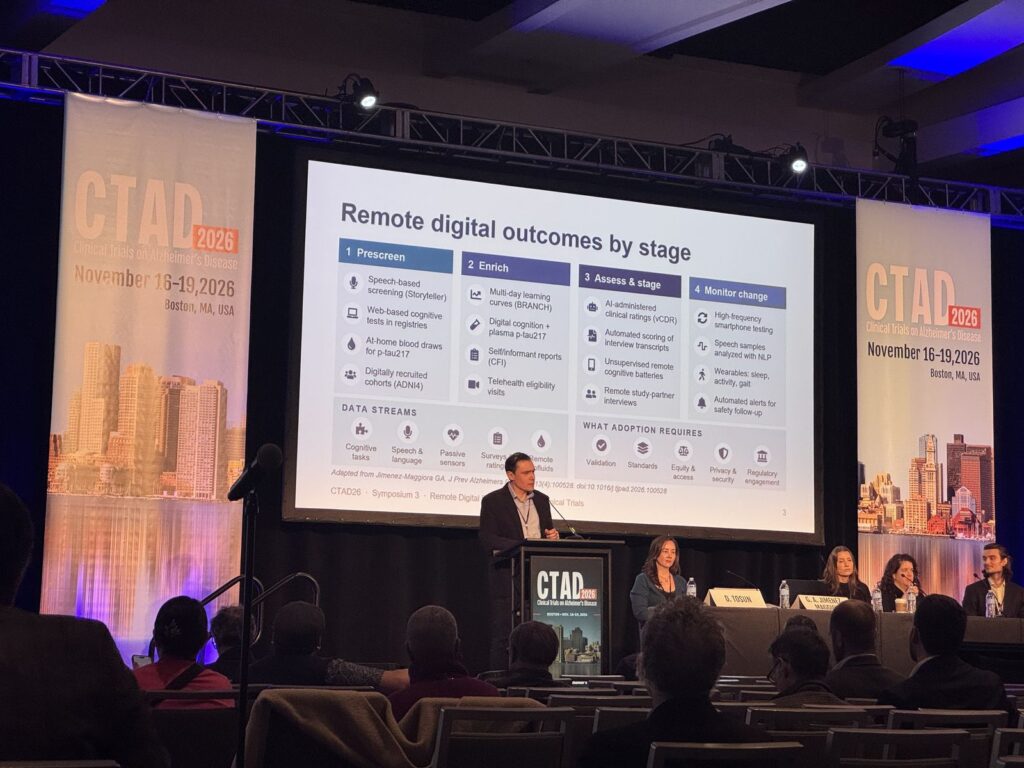
At the 19th Clinical Trials on Alzheimer’s Disease (CTAD) conference in Boston, November 16–19, 2026, our section led two sessions. Gustavo A. Jimenez-Maggiora, PhD, MBA, co-chaired Symposium 3, Remote Digital Biomarkers in Alzheimer’s Disease Clinical Trials: From Scalable Prescreening to Sensitive AI-Enabled Assessment, with Duygu Tosun, PhD, of UC San Francisco on Tuesday, November 17. Richard Gallardo III presented poster P391, Responsible Data Sharing at Scale, on how ACTC shares trial data in public and limited tiers.
Symposium 3: remote digital biomarkers
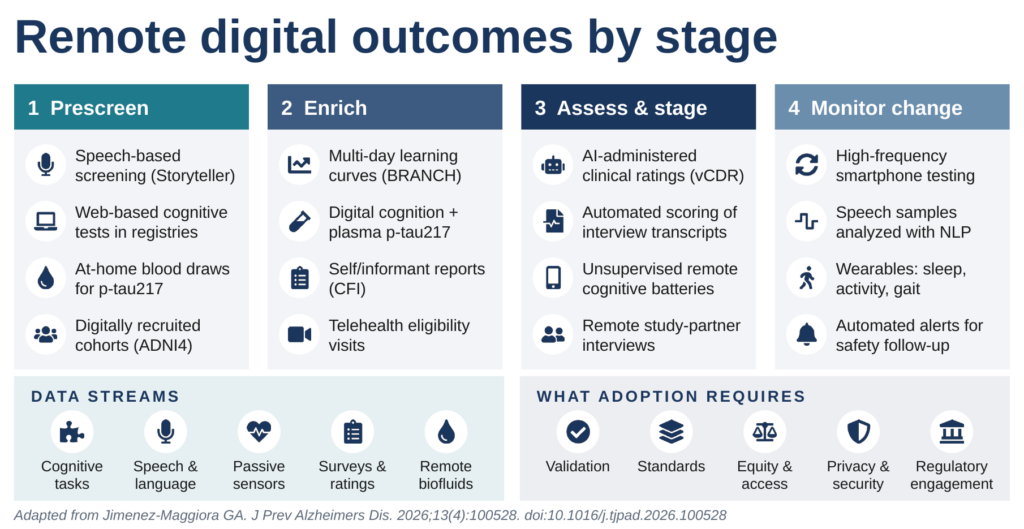
Dr. Jimenez-Maggiora opened the session with a framework for using remote digital outcomes at four stages of a trial: prescreening, enrichment, assessment and staging, and monitoring change. It is adapted from his 2026 paper in The Journal of Prevention of Alzheimer’s Disease, Remote outcome measures in Alzheimer’s disease clinical trials: A call to action. Three talks followed:
- Rachel L. Nosheny, PhD (UCSF) · The voice CDR (vCDR), a generative-AI agent that administers and scores the Clinical Dementia Rating
- Kathryn V. Papp, PhD (Brigham and Women’s Hospital / Massachusetts General Hospital, Harvard Medical School) · Digital multi-day learning curves for early detection of subtle decline in preclinical Alzheimer’s disease
- Emil Fristed, MSc (Novoic) · Self-administered speech-based prescreening for MCI in the full ADNI4 digital cohort
Dr. Tosun then led a moderated panel and audience Q&A.
Poster P391: responsible data sharing at scale
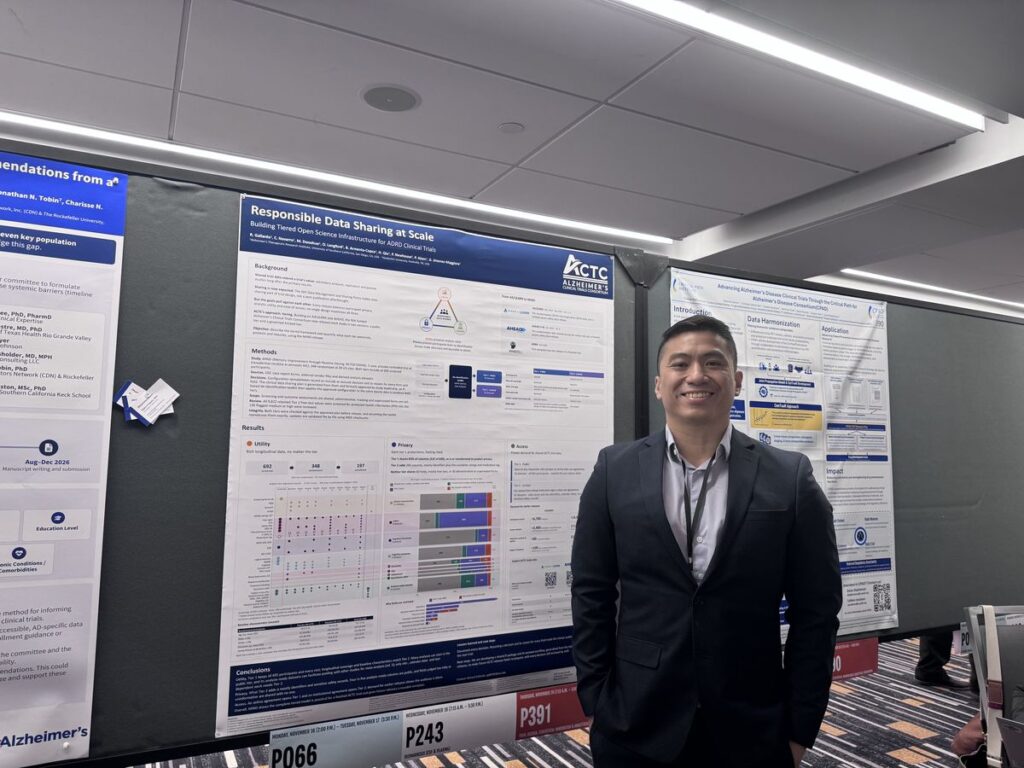
The poster describes how ACTC now shares each trial in two tiers: a public tier open to any researcher who accepts an online data use agreement, and a limited tier for researchers whose institution signs one. It uses the October 2026 release of MIND (Memory Improvement through Nicotine Dosing), the first complete two-tier release of a finished ACTC trial. The public tier keeps all 692 screened participants and every visit, and shares 65% of data columns (537 of 830) as is or transformed to protect privacy. Demand for earlier releases is strong: more than 2,400 investigators in over 60 countries and regions have requested A4/LEARN data.
More from CTAD 2026
Our team also contributed to six other CTAD abstracts, on plasma p-tau217 and amyloid PET, the AHEAD 3-45 and APEX screening cohorts, and remote cognitive assessment in registries and the APT Webstudy. See them on our Publications page.